
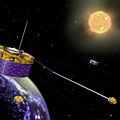
The Cluster constellation
Cluster — the Sun-Earth connection in focus
The Cluster constellation was launched in summer 2000 and started operating in early 2001. Since then, this four-satellite mission is performing the first and best ever stereo investigation of the Earth’s magnetosphere — the magnetic bubble surrounding our planet.
Thanks to Cluster, scientists have reached an unprecedented understanding of the way solar activity affects the near-Earth environment.
Cluster has provided the first 3D observation of magnetic reconnection in space — a phenomenon that reconfigures the magnetic field and releases high amounts of energy.
Cluster pioneered measurements of electric currents in space, revealed the nature of black aurorae, and discovered that plasma — a gas of charged particles surrounding Earth — makes ‘waves’.
The Cluster mission has been extended twice in the past, up to June 2009. The new extension will make it possible to study the auroral regions above Earth’s poles and widen the investigations of the magnetosphere — its inner region in particular.